
press · In-depth
The white-gold Cartier Cheich that came 25 years later
The Cartier Cheich was created as a prize for an almost impossible Paris-Dakar challenge. Only one rider ever earned one. Then, decades after the competition had ended, Giorgio Seragnoli convinced Cartier to make another.
Piece unique
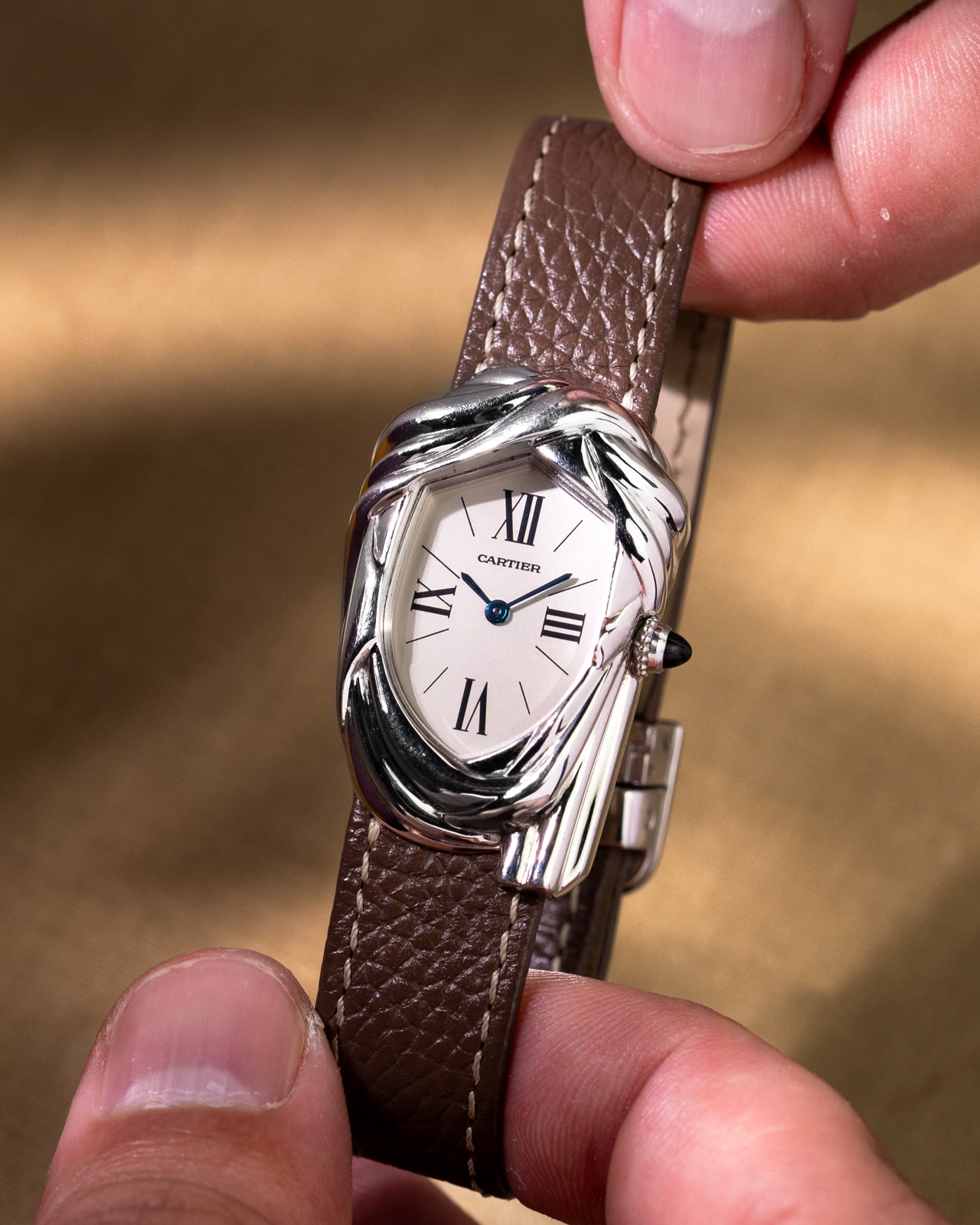
From the beginning, the Cartier Cheich was never really supposed to be a watch you could walk into Cartier and buy.
Its story starts in the early 1980s with the Paris-Dakar Rally, when Cartier president Alain Dominique Perrin and rally founder Thierry Sabine came up with an unusual idea. Beginning in 1983, a competitor who could win the Paris-Dakar twice consecutively in the same vehicle category would receive a Cartier watch created specifically for the challenge.
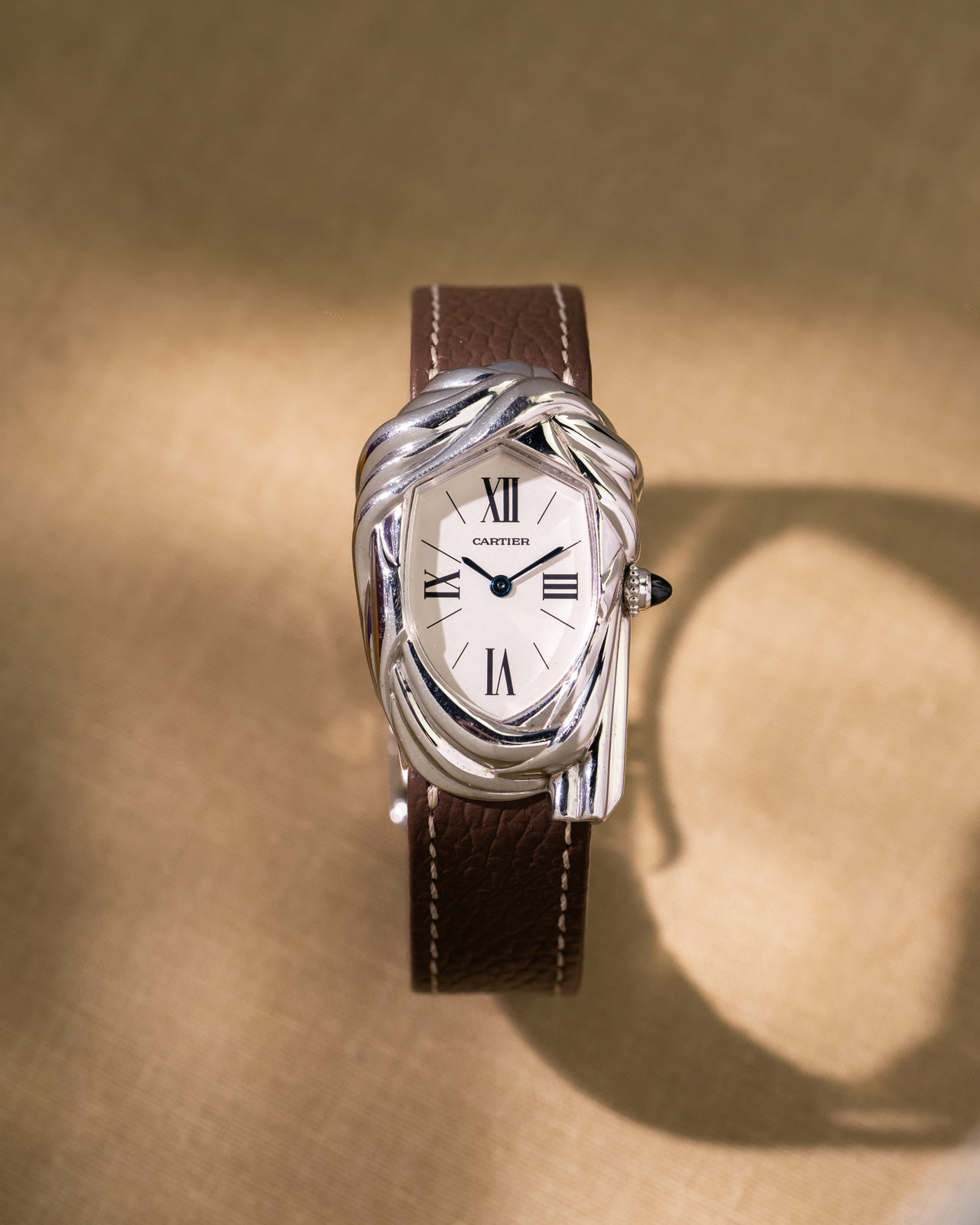
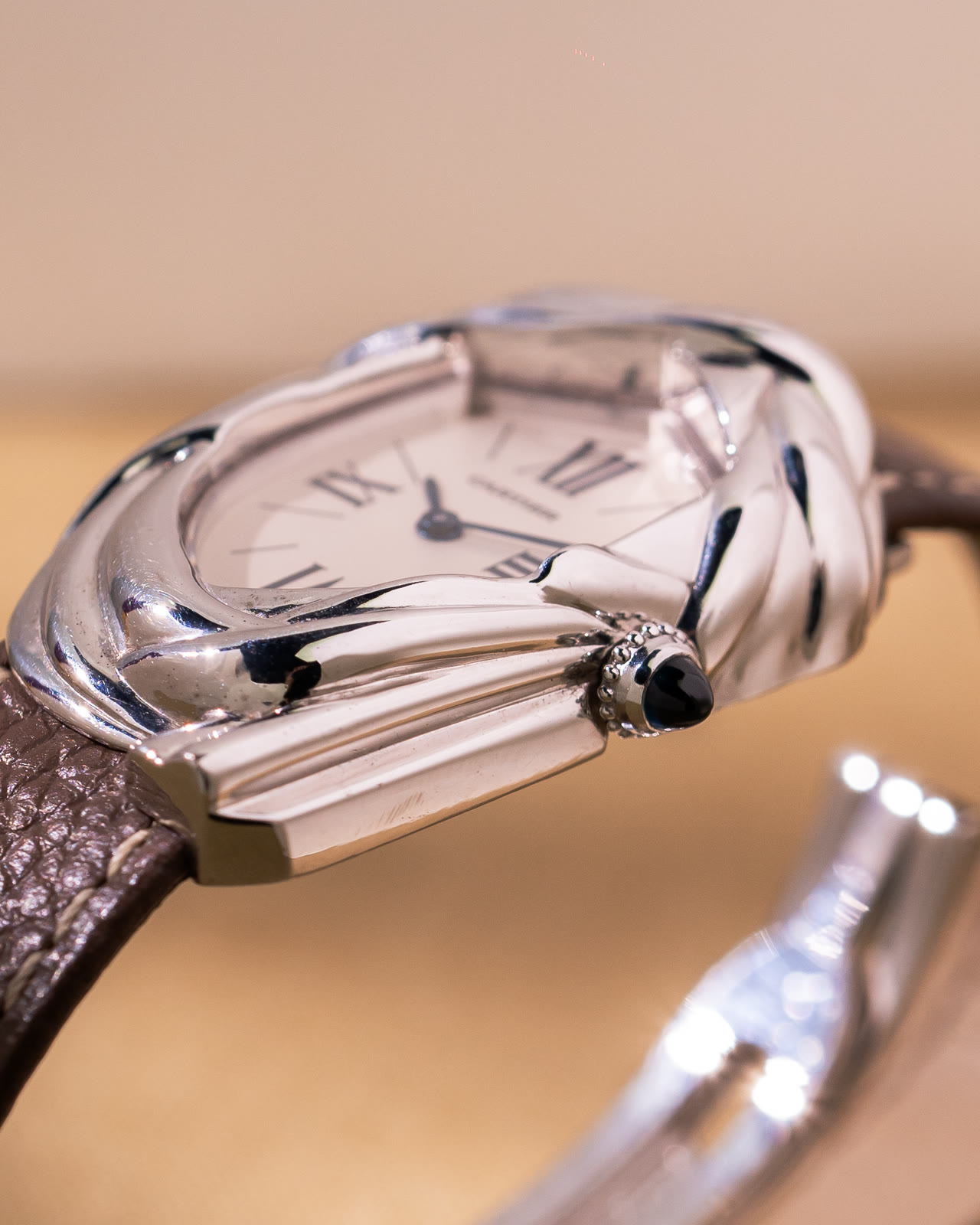
The result was the Cheich, and even its design belonged to the rally. Cartier took inspiration from the Tuareg headscarf depicted in the Paris-Dakar logo, translating the folds of fabric into layers of gold surrounding a relatively small dial. It looked unlike the Tank, Santos or almost anything else associated with Cartier, because it had been designed around a very particular place and purpose.
Gaston Rahier wins the Cheich
The challenge was extraordinarily difficult to complete. Belgian motorcycle racer Gaston Rahier won the Paris-Dakar in 1984 and returned the following year to win again. In doing so, he became the first, and ultimately the only, competitor to satisfy Cartier’s conditions and receive the Cheich.
When Thierry Sabine died in a helicopter accident during the 1986 rally, the Cartier Challenge came to an end. The unusual watch created for it could easily have disappeared into a small corner of Cartier history. For more than two decades, that appeared to be exactly what had happened.
The four original Cheich watches
Rahier was the only person to earn a Cheich through the rally. Cartier had prepared four examples during the original period.
- The men’s prize eventually awarded to Rahier.
- A women’s version prepared in case a female competitor completed the challenge.
- An example made for Thierry Sabine himself.
- Another men’s prize waiting for the next qualifying winner.
That winner never came. Sotheby’s records two of those original watches as being held in Cartier’s archive collection, while Sabine’s example is currently unlocated. Rahier’s watch remained with his family until it was eventually consigned to auction in 2022.
Had the story ended there, the Cheich would already have been one of Cartier’s more unusual creations. Four watches tied directly to the Paris-Dakar, born from a competition that lasted only a few years, with just one actually awarded for completing the challenge.
Seragnoli brings the Cheich back
But in 2010, Giorgio Seragnoli gave the story an unexpected second chapter. Seragnoli was particularly interested in Cartier watches made in white metals and had co-authored Cartier Bianco with Osvaldo Patrizzi. At some point that interest reached this shape in Cartier’s history, and he commissioned the maison to revisit the Cheich.
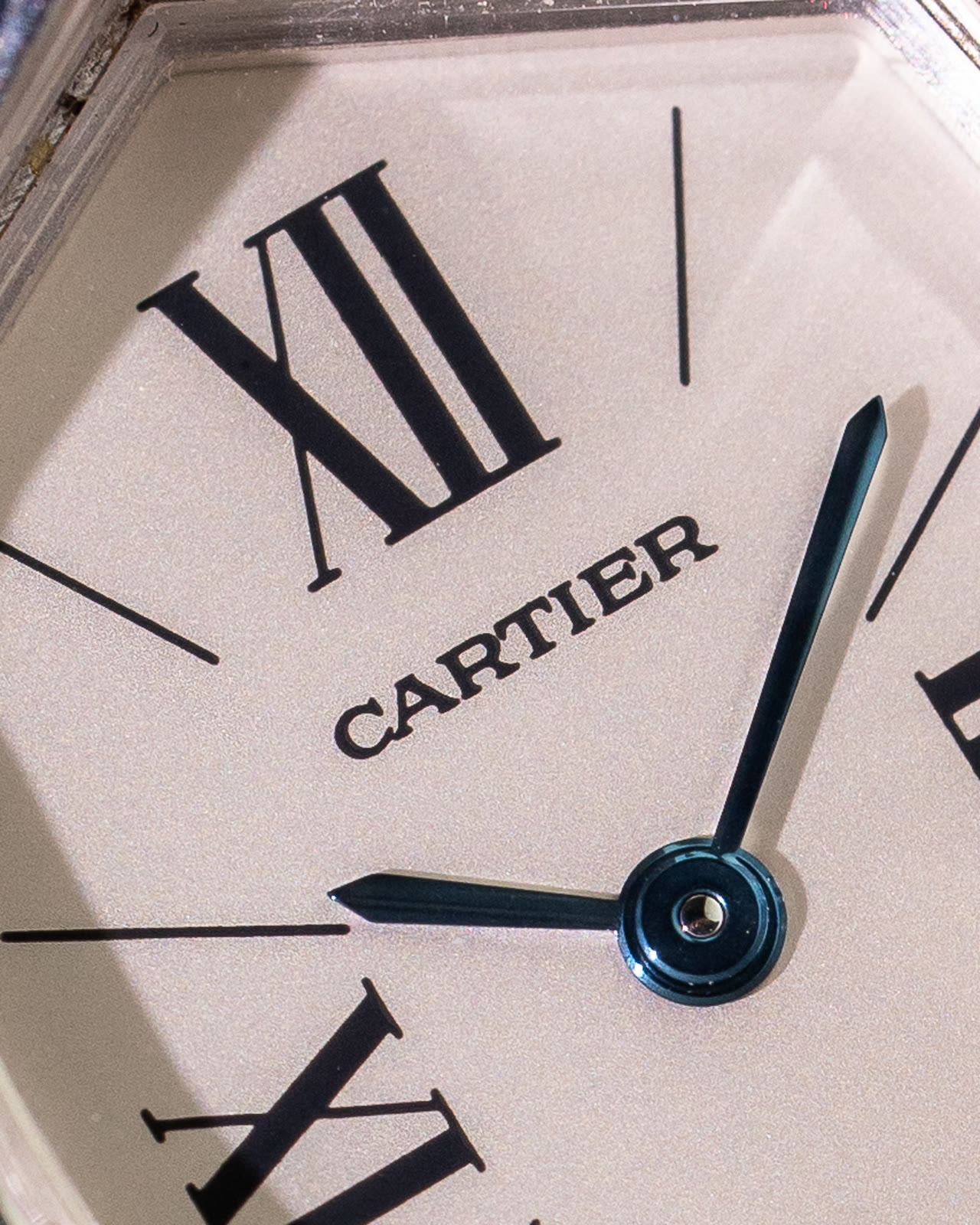
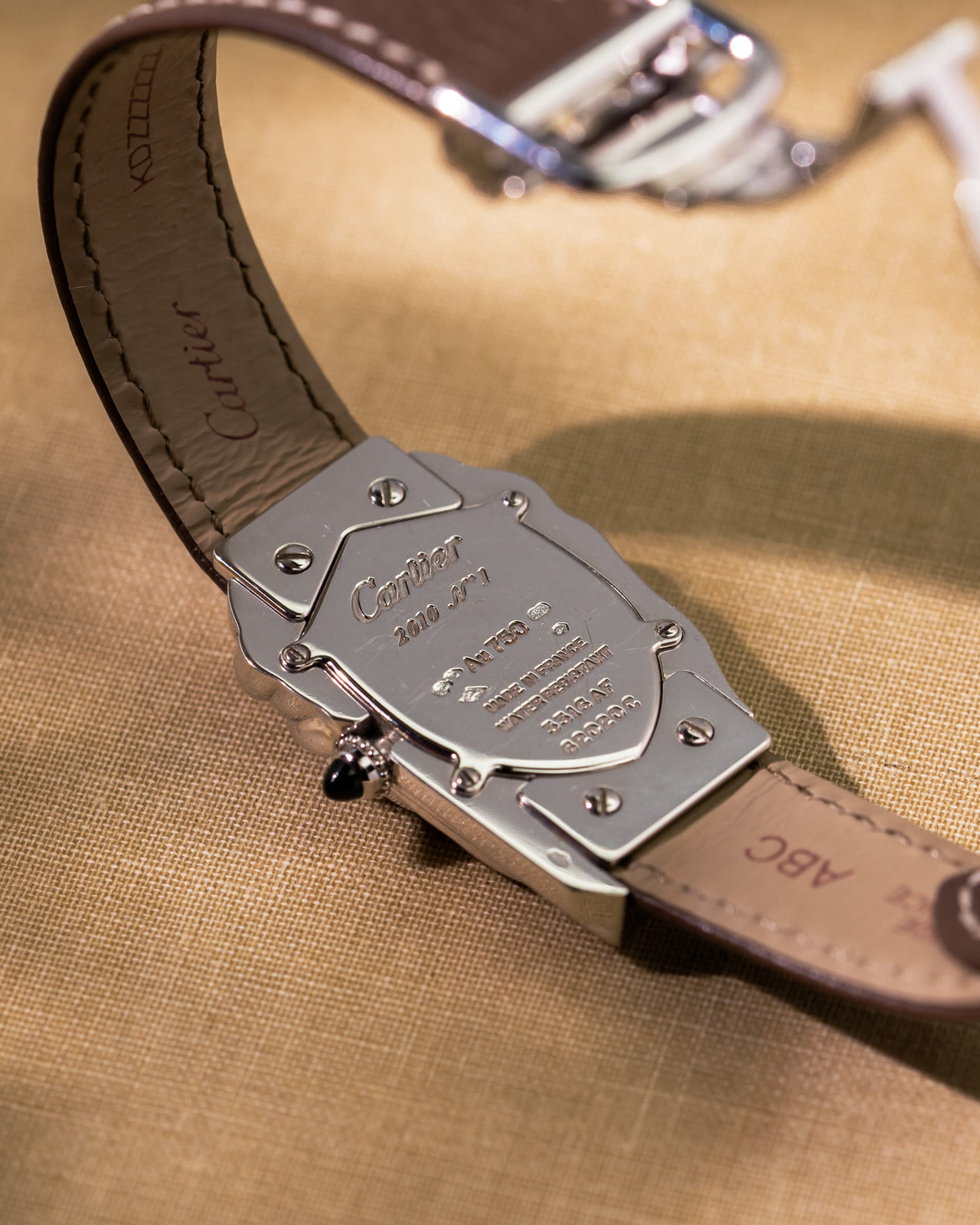
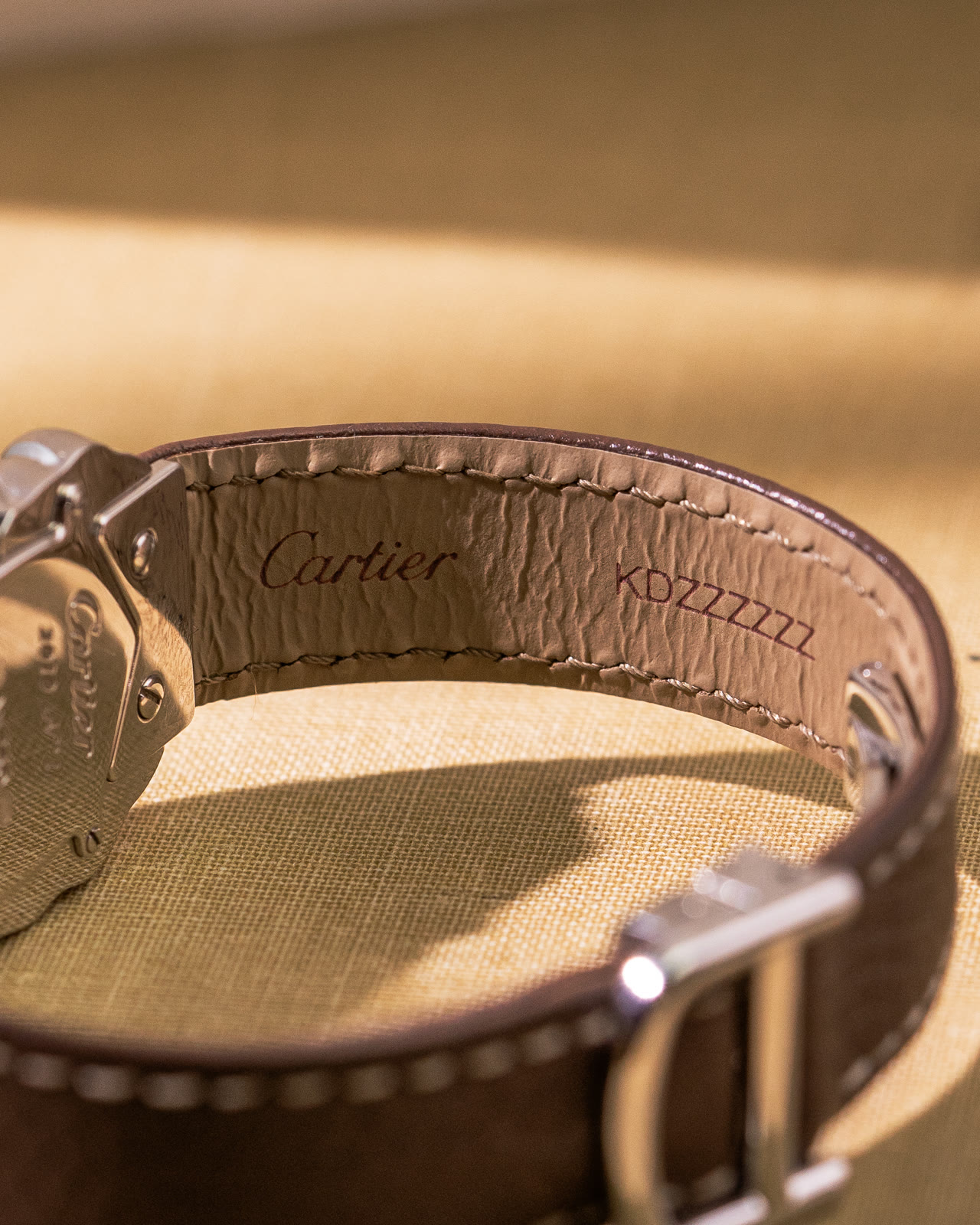
Cartier agreed. The result was a unique Cheich in white gold, carrying “No. 1” and the year 2010 on its caseback.
More than two decades had passed since the Cartier Challenge ended, and this watch had no rally victory attached to it. It existed because a collector had gone back into Cartier’s history and asked the company to make something it had never made in this form before.
That makes Seragnoli’s watch a curious exception within an already unusual story. The first four Cheich watches existed because of the Dakar. Someone cared enough about Cartier to bring the design back for a fifth.
Then it appeared in a red pouch
Perhaps the best part of the modern story happened twelve years later. Collectors Gallery has described a lunch in 2022 during which a contact passed the team a red pouch underneath the table. They opened it and found a Cartier Cheich they hadn’t known existed. It was Seragnoli’s white-gold watch.
For a design with only four known historical examples associated with its original creation, suddenly being confronted with another one must have been a strange moment. The “No. 1” and 2010 marking on the back pointed towards a completely different story, eventually leading back to Seragnoli and his special order.
The timing made the discovery even more interesting. That same year, Gaston Rahier’s family consigned his original Cheich to Sotheby’s. Rahier had earned it by winning the Paris-Dakar twice, roughly 25 years before Seragnoli’s commission. They arrived at the same design from completely different directions.
And perhaps that is why the white-gold Cheich is so interesting. It is rare in the conventional sense. Its existence changes what had previously seemed like a closed chapter in Cartier’s history.
From a private commission to an auction record
Sixteen years after it was made for Seragnoli, and four years after Collectors Gallery encountered it in that red pouch, the white-gold Cheich appeared at Sotheby’s Important Watches auction in Hong Kong in September 2026.
By then, the story surrounding the watch was considerably better understood. It was a later, unique commission from an important Cartier collector, executed entirely in white gold.
The market responded accordingly. According to Hodinkee, the watch sold for approximately HK$26.5 million including fees, around US$3.4 million, setting a new auction record for a Cartier wristwatch.
The fifth Cartier Cheich
It is tempting to make the price the story, especially when a Cartier crosses the three-million-dollar mark. The journey to that result is interesting in itself.
In 1983, Cartier created a watch that couldn’t really be bought. The route to owning one ran through the Paris-Dakar Rally and required winning it twice in succession. Gaston Rahier managed exactly that, and no one else won the Cartier Challenge.
Twenty-five years after Rahier’s second victory, Giorgio Seragnoli found another route. It ran through a deep interest in Cartier, a fascination with its watches in white metals and the kind of relationship with the maison that could result in a long-forgotten design being brought back for one person.
That is how a story that appeared to end with four Cheich watches in the 1980s eventually became a story about five. And more than forty years after Cartier created the Cheich as a prize that money couldn’t buy, its only white-gold example became the most expensive Cartier wristwatch ever sold at auction.
Price and availability
Production. A piece unique, made once by the brand.
Price. A unique commission with no retail price. It sold at Sotheby's in Hong Kong in September 2026, for HK$26,520,000 including fees, about US$3.4 million, against an estimate of HK$8 to 40 million. Sotheby's publishes results only behind a login, so the figure is the one reported by the watch press. (Hodinkee, as of Sep 2026)
The watch was offered at Sotheby’s Important Watches auction in Hong Kong in September 2026.
Specification
Case
- Material
- 18k white gold
- Back
- Secured by four screws
- Size
- 38 mm length x 27 mm width
- Numbers
- No. 1, 3316AF and 62020C
Movement
- Calibre
- Quartz, jewelled
Details
- Dial
- white
Price
- Price
- A unique commission with no retail price. It sold at Sotheby's in Hong Kong in September 2026, for HK$26,520,000 including fees, about US$3.4 million, against an estimate of HK$8 to 40 million. Sotheby's publishes results only behind a login, so the figure is the one reported by the watch press. (Hodinkee, as of Sep 2026)
Sources
- Sotheby's, lot: Cheich, a historically important and unique white gold wristwatch, circa 2010 (Important Watches, Hong Kong, September 2026)
- Sotheby's, digital catalogue: Fine Watches, section The Cartier Cheich, From Triumph to Tragedy (2022)
- Sotheby's, lot 101: Gaston Rahier's Cartier Cheich (Fine Watches, Paris, September 2022)
- Collectors Gallery, sourcing account: Cartier Cheich
- Hodinkee, report of the Hong Kong result (18 September 2026)