
hands-on
The Ulysse Nardin Super Freak needs a gimbal for seconds
After visiting Ulysse Nardin's museum in Le Locle, we spent time with the Super Freak at Geneva Watch Days. Its mechanics include twin flying tourbillons, a vertical differential and a 4.8 mm gimbal. What stayed with us was the blue under the light, the smooth bezel setting and how naturally it wore.
Limited · 50
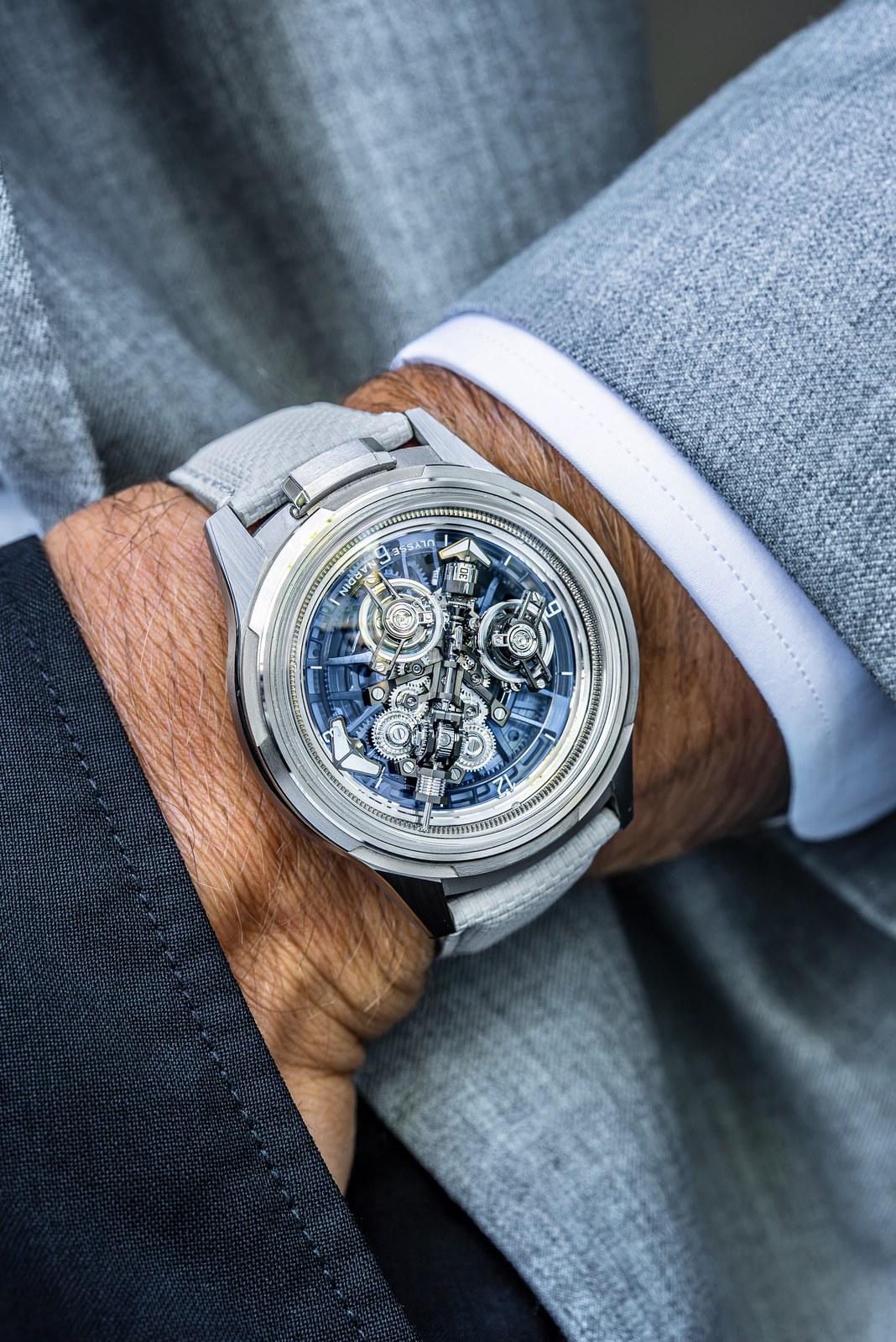
Twenty-five years after the original Freak, Ulysse Nardin has taken its most unconventional idea further than ever. But after spending time with the Super Freak during Geneva Watch Days, it wasn’t the complexity that stayed with us.
For a watch with 511 components, two flying tourbillons and four years of development behind it, the most surprising thing about the Super Freak is how natural it feels on the wrist.
Le Locle and the original Freak
Our understanding of Ulysse Nardin changed about a year ago, during a visit to the brand’s museum in Le Locle. Seeing that history gathered in one place gives you a very different perspective on what Ulysse Nardin is doing today.
There is much more depth to the brand than the watches most of us encounter today, and if you ever have the opportunity to visit the museum, we would genuinely recommend it. It also gives the Freak more context.
Introduced in 2001, the original Freak challenged one of the most familiar ideas in watchmaking. Instead of conventional hands over a dial, the movement itself became part of the display, rotating around the watch to indicate the minutes. Twenty-five years later, Ulysse Nardin is still developing that idea.
During Geneva Watch Days, we spent some time with the Ulysse Nardin team and had the chance to get properly hands-on with the Super Freak. On paper, there is an enormous amount to take in. But once we had it in our hands and eventually on the wrist, we found ourselves thinking much less about the numbers.
Inside the UN-252
Innovation within the Freak collection isn’t particularly surprising anymore. What we find more interesting is that Ulysse Nardin continues to push a concept that would have been very easy to leave alone.
The Super Freak introduces the new calibre UN-252, developed over four years and made from 511 components.
Two flying tourbillons sit within the rotating architecture, each inclined by ten degrees and rotating in the opposite direction to the other. Their rates are combined through a tiny vertical differential before the energy continues towards the seconds indication.
A gimbal for seconds
That seconds display is worth understanding because it says a lot about the way this watch has been developed.
The Freak’s movement is also its minute display, meaning the architecture itself is constantly travelling around the face of the watch.
Adding seconds therefore required Ulysse Nardin to develop a patented mechanical gimbal measuring just 4.8 mm. It maintains the connection as the geometry around it changes, eventually driving the small cylindrical seconds display.
It is an incredibly complicated solution for something as familiar as displaying the seconds. You don’t necessarily notice any of this when you first look at the watch. But once it has been explained, you start looking through the crystal differently.
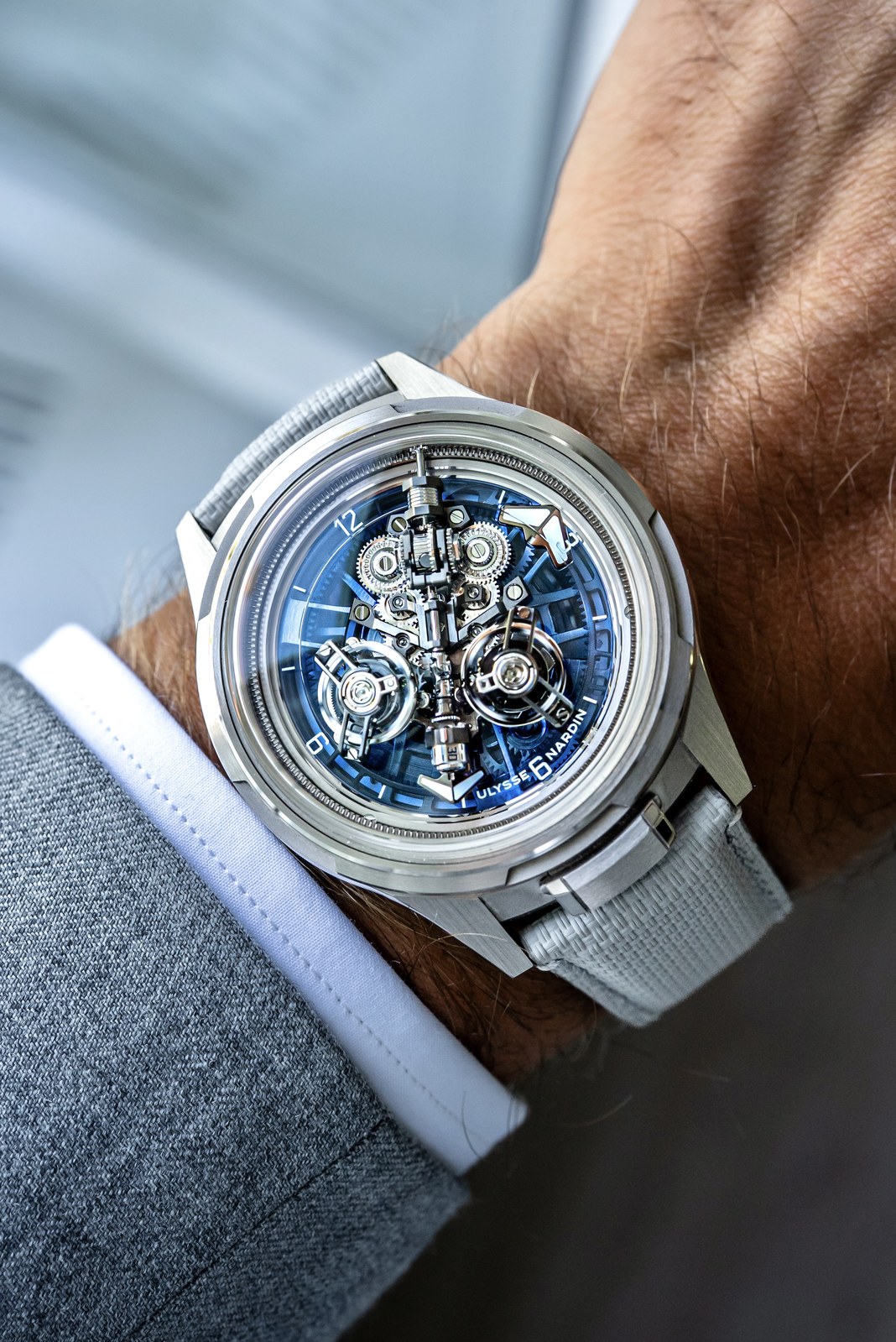
The Super Freak in motion
The Super Freak makes considerably more sense in person than it does in photographs. There is a lot happening beneath the crystal. The architecture exists at different depths, the two tourbillons are constantly moving and the transparent blue Nanosital hour disc sits above much of the mechanics underneath. A photograph freezes all of that.
On the wrist, the watch is constantly changing. Different parts of the calibre appear as the movement travels around the display, the blue changes with the light and the depth of the construction becomes much easier to appreciate.
The blue is what made this version work for us immediately. Against the white-gold case and grey strap, it gives the watch enough colour without taking attention away from everything happening underneath.
There is also something fascinating about watching a mechanism this complicated operating only a few centimetres from your hand. You can understand the basic principle and still find yourself looking at it wondering exactly how everything is working together. That feeling is a large part of the attraction.
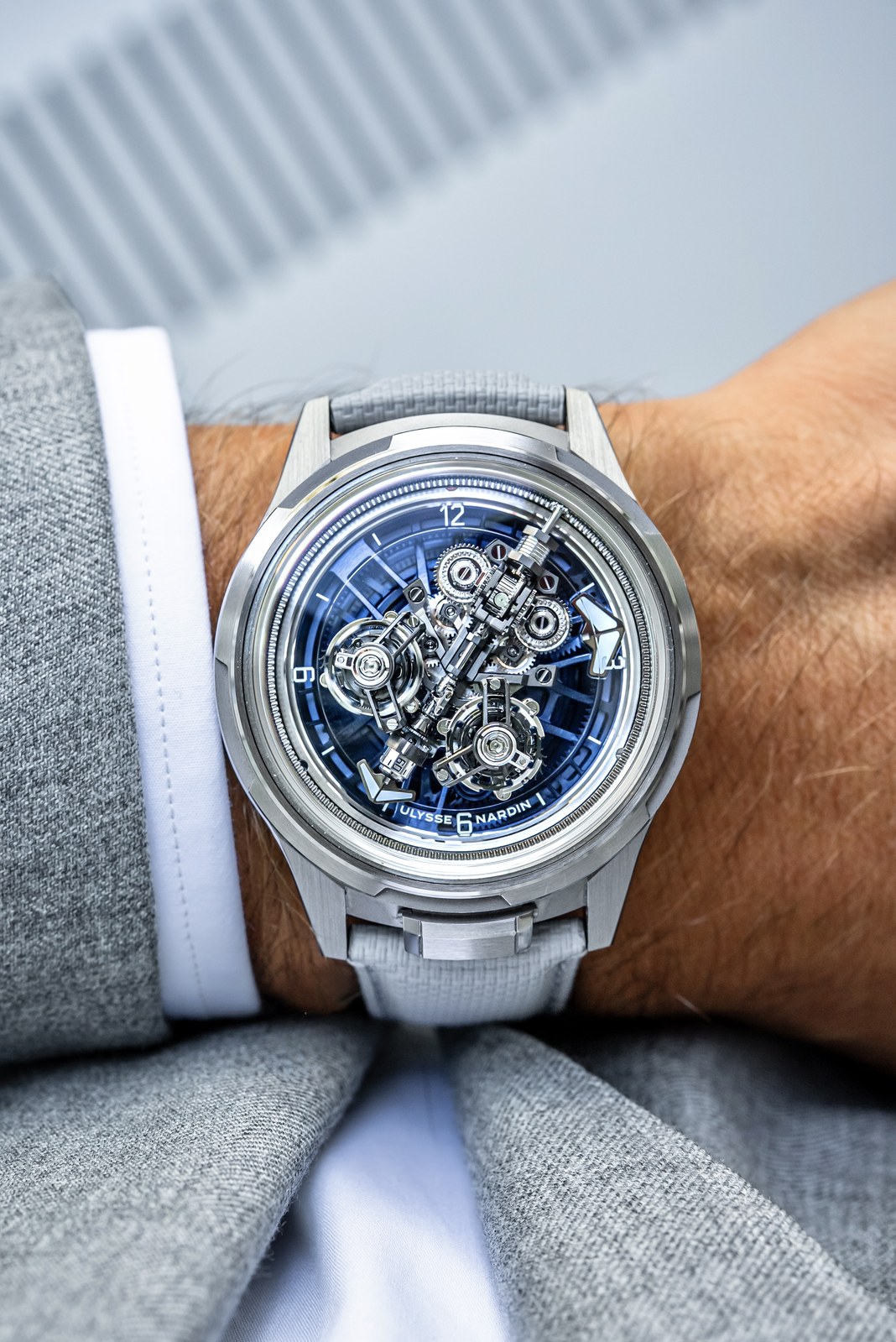
Setting the time through the bezel
The Super Freak doesn’t have a conventional crown. Instead, the bezel is used to set the time. It sounds like a small detail until you actually use it.
As you adjust the watch, you can see the architecture moving with you, and the smoothness of that movement is genuinely impressive. Knowing how much is happening mechanically underneath makes the experience even more satisfying.
This was one of the moments during Geneva Watch Days when the technical side of the watch became more tangible. Reading that a calibre contains 511 components tells you that it is complicated. Feeling everything move smoothly as you interact with it tells you something completely different about how well that complexity has been resolved.
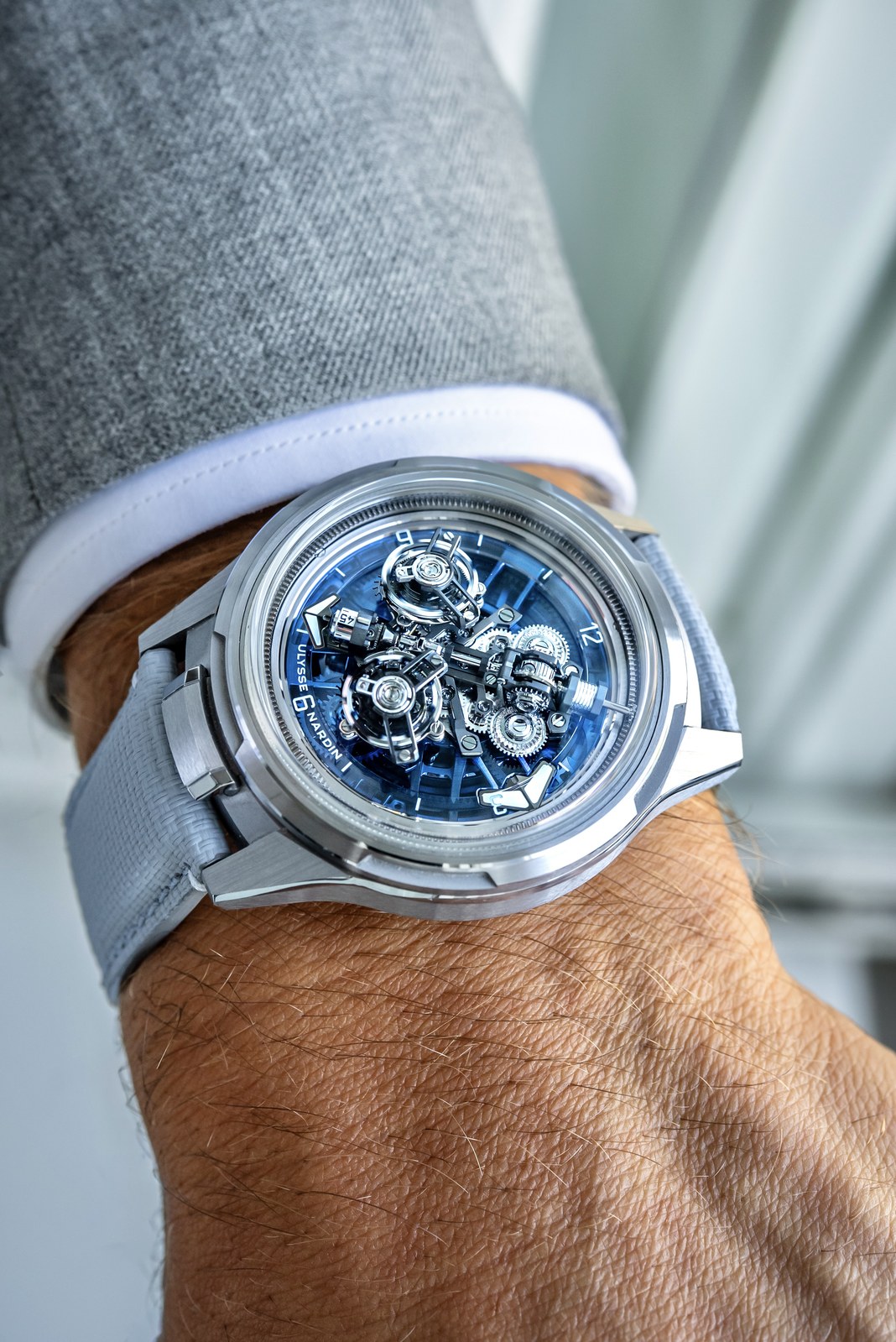
Forty-four millimetres on the wrist
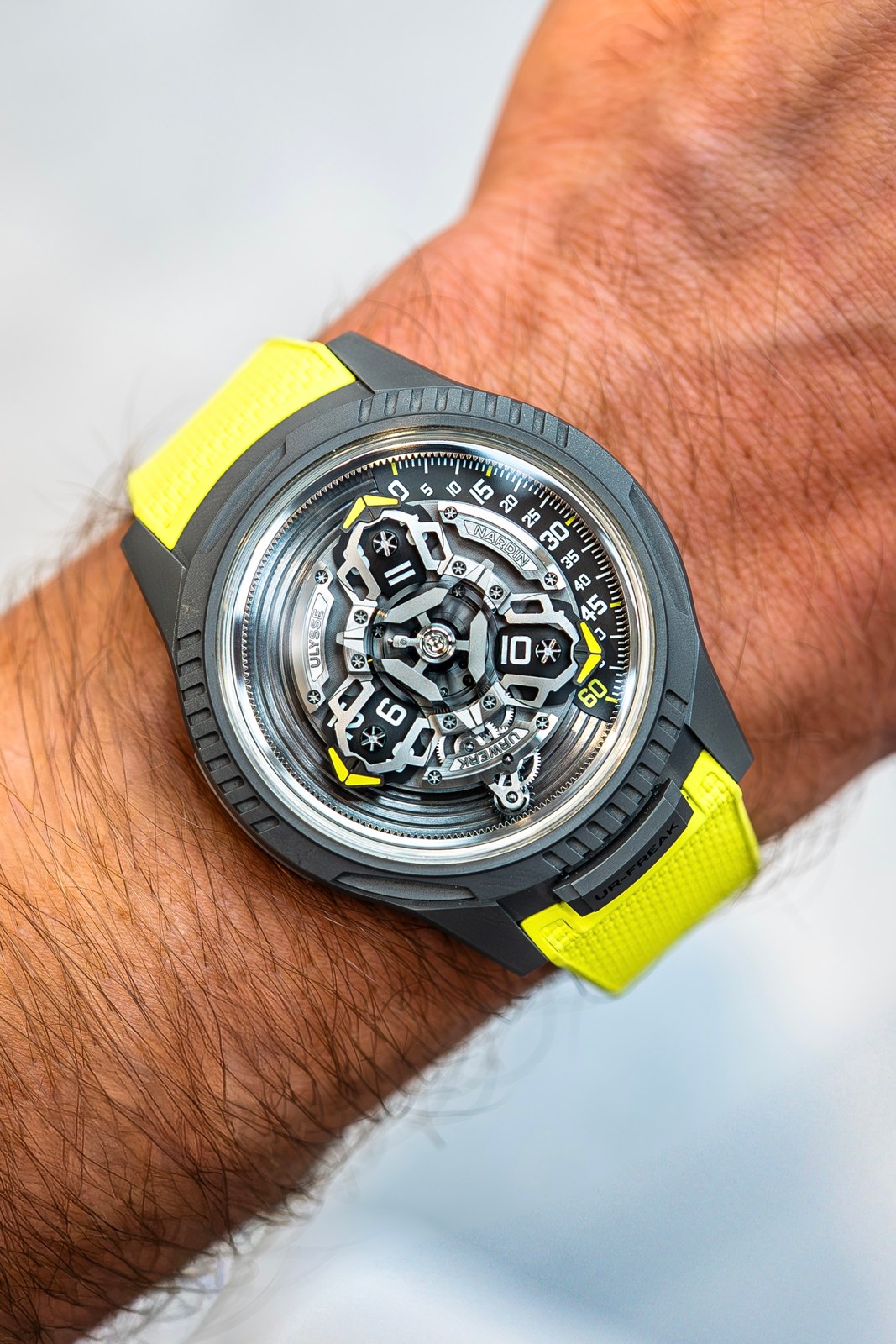
At 44 mm, this is obviously not a small watch. On a fairly large wrist, the proportions work naturally, but the comfort was still a surprise. The grey rubber strap is an important part of that.
It sits naturally around the wrist and gives the white-gold case and exposed mechanics a much more relaxed character. There is an enormous amount of serious watchmaking here, yet it doesn’t feel like a watch that needs to be treated too seriously when you are actually wearing it. That is something we appreciate.
With a suit and white cuff during Geneva Watch Days, it felt completely at home, but it is just as easy to imagine it worn much more casually. The strap takes what could have been an intimidating piece of high watchmaking and makes it feel contemporary and genuinely wearable.
The Freak ONE OPS and the Super Freak are very different watches, but both have the same effect on the wrist. They make technical watchmaking feel less distant.
The Freak, twenty-five years on
Having seen more of Ulysse Nardin’s history over the past year, the Super Freak is also easier to place within the bigger picture.
There is an increasingly independent spirit to the way the brand approaches watches like this, expressed in the freedom to pursue unusual mechanical ideas and continue developing them without needing the result to look or behave like everything else around it. That progression is something we appreciate about Ulysse Nardin right now.
The Freak was already radical in 2001. Twenty-five years later, the interesting part isn’t that Ulysse Nardin can still make an unusual watch. It is that the brand continues to find new mechanical problems to solve within an idea that has existed for a quarter of a century.
Back on the wrist
And after spending time with the Super Freak, we came back to the same thing that surprised us when we first put it on.
The UN-252 took four years to develop. There are 511 components inside, two flying tourbillons, a vertical differential and a tiny gimbal solving a problem most watches never have in the first place.
Yet on the wrist, none of that complexity gets in the way. What we remember is the blue under the light, the smoothness when setting the time, the movement slowly making its way around the display and how naturally the grey rubber strap sat around the wrist.
Perhaps that is the most interesting part of the Freak’s evolution. It has become considerably more complicated, without becoming more complicated to enjoy.
Price and availability
Production. Monochrome's launch report and the official page state a limited edition of 50 pieces.
Retail. CHF 320,000 / €348,100 / $361,600, as of Apr 2026 (prices reported by Monochrome, 14 April 2026; USD excl. VAT)
The prices are those Monochrome reported on 14 April 2026. Only the US dollar figure is stated excluding VAT.
Specification
Case
- Diameter
- 44 mm
- Height
- 16.54 mm overall; 12.2 mm "perceived thickness" (Monochrome)
- Material
- white gold
- Crown
- none; the bezel sets the time, winding through the open caseback
- Water Resistance
- 30 m
Movement
- Calibre
- UN-252
- Type
- manufacture automatic, Grinder winding system; two inclined flying tourbillons on the minute bridge, combined by a vertical differential
- Functions
- hours, minutes, seconds (cylindrical seconds display driven through a gimbal)
- Power Reserve
- 72 hours
- Frequency
- 2 × 2.5 Hz (2 × 18,000 vph)
- Components
- 511 parts
- Escapement
- DIAMonSIL escapements; silicon balance wheels and hairsprings
- Notable
- 5 mm vertical differential of 69 parts with eight ceramic ball bearings, described by Ulysse Nardin as the world's smallest; 11-component gimbal measuring 4.8 mm; tourbillons inclined at ten degrees, one turn in sixty seconds, rotating in opposite directions; more than 70 per cent of the components hand-finished (Monochrome)
Details
- Dial
- no conventional dial; transparent blue Nanosital hour disc with white Super-LumiNova markers, seven planes under the crystal (Monochrome)
- Straps
- grey ballistic rubber strap with white stitching, white-gold deployant buckle
Price
- Retail
- CHF 320,000 / €348,100 / $361,600, as of Apr 2026 (prices reported by Monochrome, 14 April 2026; USD excl. VAT)
Sources
- Jimmy Heneidy, first-hand account of the Super Freak at Geneva Watch Days (to The Crown Journal, 14 September 2026)
- Ulysse Nardin, Super Freak model page (exact reference 2520-500LE-3A-BLUE/3A)
- Monochrome, The New Ulysse Nardin Super Freak (14 April 2026)
- Ulysse Nardin, A legacy of precision (the museum and archives in Le Locle)
- Ulysse Nardin, Freak ONE OPS model page
Read next
![The Diver [AIR] held in a dark-gloved hand, the mottled CarbonFoil bezel and the orange strap close up](/img/ulysse-nardin/tcj-diver-air-gloved-hand.jpg)
In-depth
The Ulysse Nardin Diver [AIR] is a dive watch under 52 grams
In-depth Limited · 100