
press · In-depth
Bovet's Récital 18 Shooting Star: the world on half a globe
For the Récital 18 Shooting Star, released in 2016, Bovet asked a cartographer for a map that does not exist in nature: the entire Earth on a single hemisphere. Around it came a second hemisphere for the moon, two rollers carrying twenty-four city names, jumping hours over retrograde minutes, and a five-day tourbillon. Fifty pieces, red or white gold.
Limited · 50
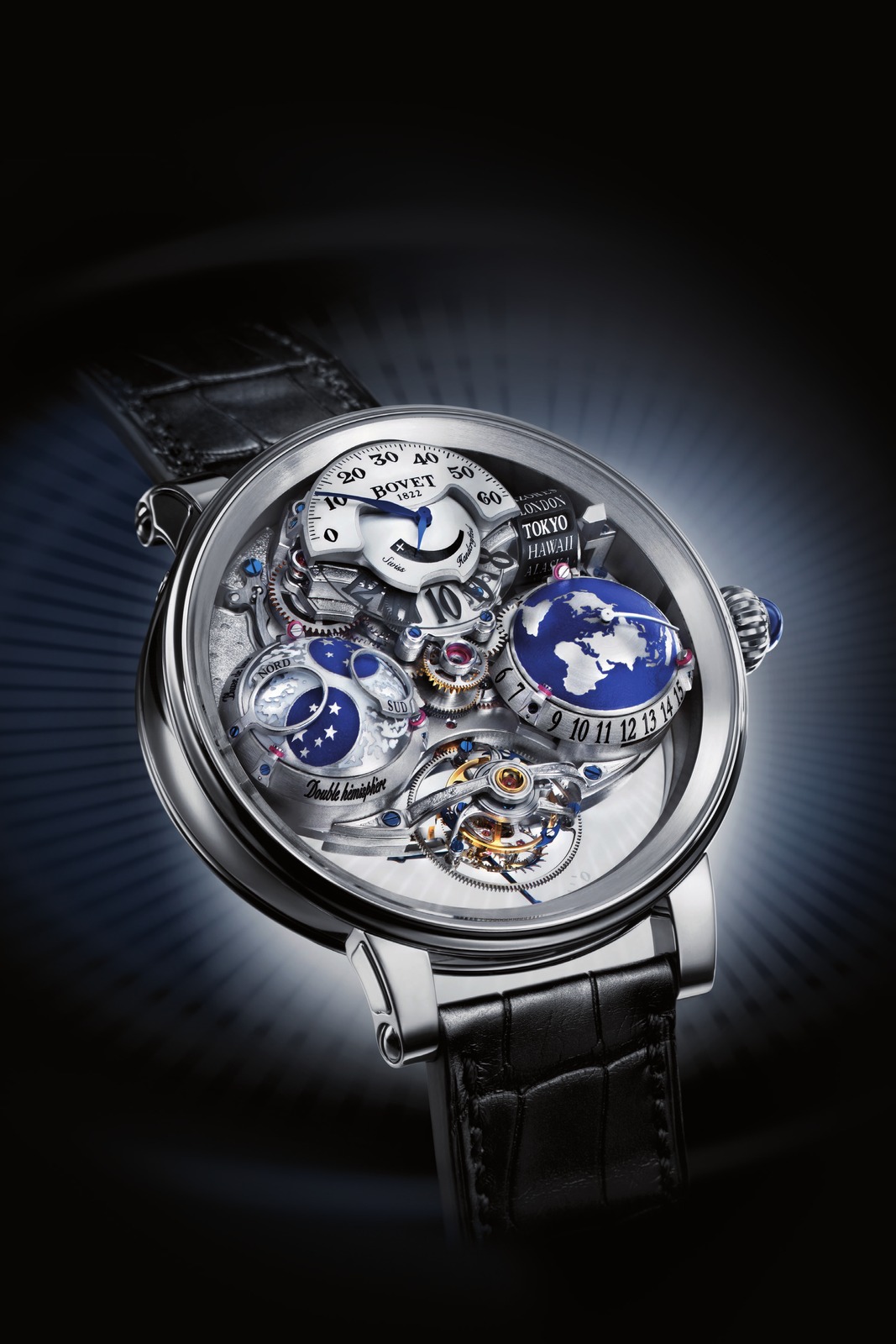
In 2016, Bovet commissioned a cartographer to compress the entire surface of the Earth onto a single hemisphere, then machined that drawing into a dome. The other displays on the 50-piece Récital 18 Shooting Star were built around it.
The whole Earth on half a globe
The premise, in the release’s own telling, was a change of viewing distance. Seen from space, only half the planet is visible at once; so the house had the whole of it drawn onto one hemisphere, engraved the relief, and filled the oceans with luminescent blue.
The dome sits at 3 o’clock and carries universal time. A hemispheric hand, fixed at the North Pole, follows the curve of the globe; a 24-hour ring surrounds it, so the time anywhere in the world reads off a straight line from the globe’s centre through the chosen place.
The same idea repeats at 9 o’clock, where a second dome shows the moon through two circular apertures, one for each terrestrial hemisphere, driven by a mechanism the release rates at one day of error in 122 years.
Both domes ride on three adjustable ruby runners around their rims, an arrangement the release calls patented, which spares the poles a pivot.
Twenty-four cities on two rollers
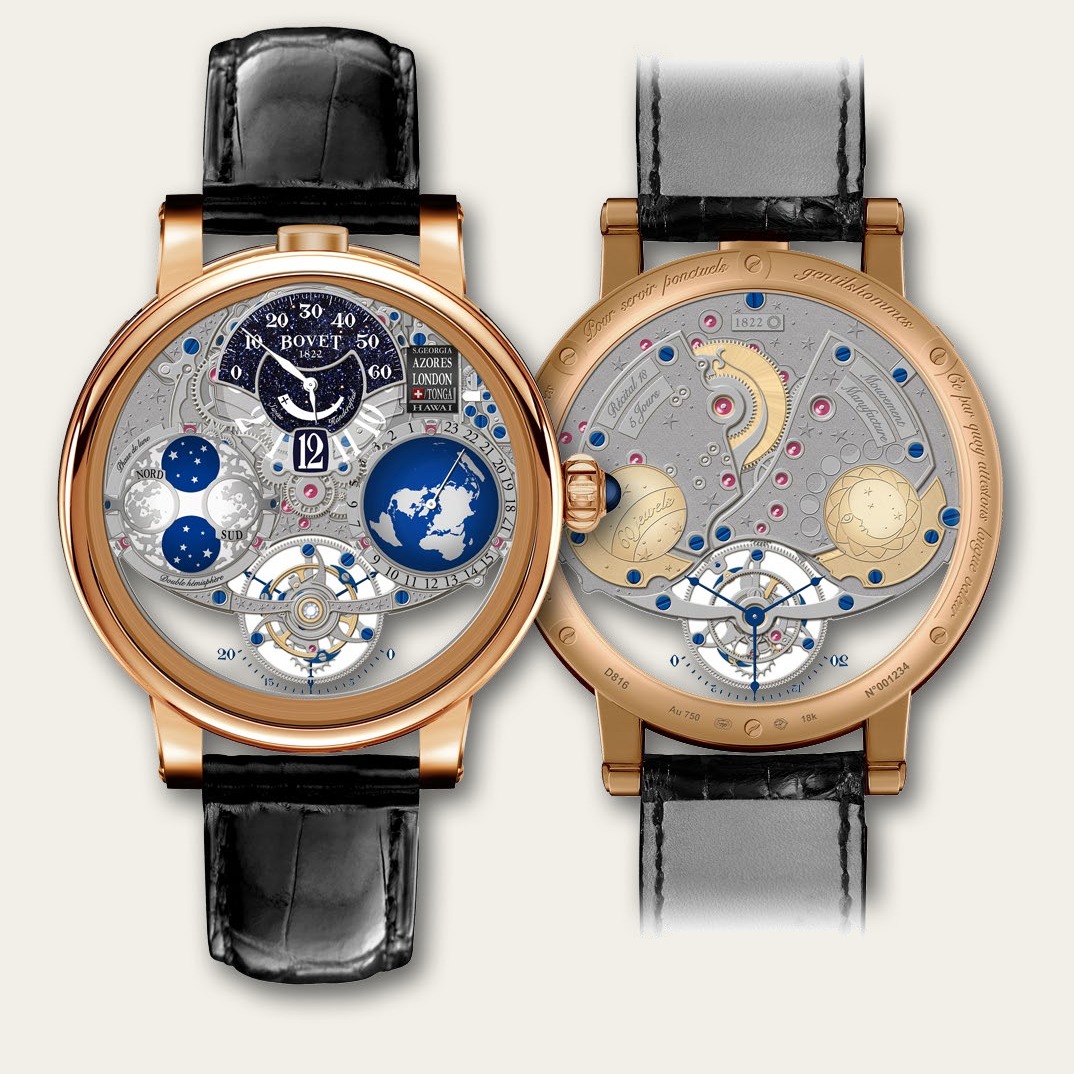
For the city names, Bovet chose rollers over a printed ring. According to the release, the outer roller shows 11 cities at once, then gives way to a window onto an inner roller supplying the remaining city names, the whole sequence indexed by a column wheel. Black rhodium cylinders, city names engraved and lacquered white.
Each press on the centre of the crown jumps the time-zone hand by 15 degrees, one full zone, and turns the rollers in step. The correction itself is spring-loaded and fires when the finger releases, so the mechanism receives one measured push rather than whatever pressure the owner applied. The release describes a patent filing for this constant-force corrector.
That corrector is the detail worth returning to a decade later.
Jumping hours over a five-day tourbillon
The third dome, at 12, stacks the rest of the display: jumping hours on a sapphire disc, the power reserve curved in its centre, retrograde minutes above. Synchronising an instantaneous hour jump with a retrograde minute hand is a problem the house says it had already mastered elsewhere in the collection.
Underneath, two barrels provide five days of reserve. A one-minute tourbillon at six regulates the watch at 21,600 vph through the DIMIER escapement. The hairspring is made in-house, a craft the release claims fewer than ten watchmaking companies possess.
The seconds read from a triple hand under the carriage against a graduation printed inside the crystal. Across the movement’s visible surfaces, front and back, the engravers cut a constellation by hand. On the back, two gold domes rise above it. The right-hand dome represents the moon.
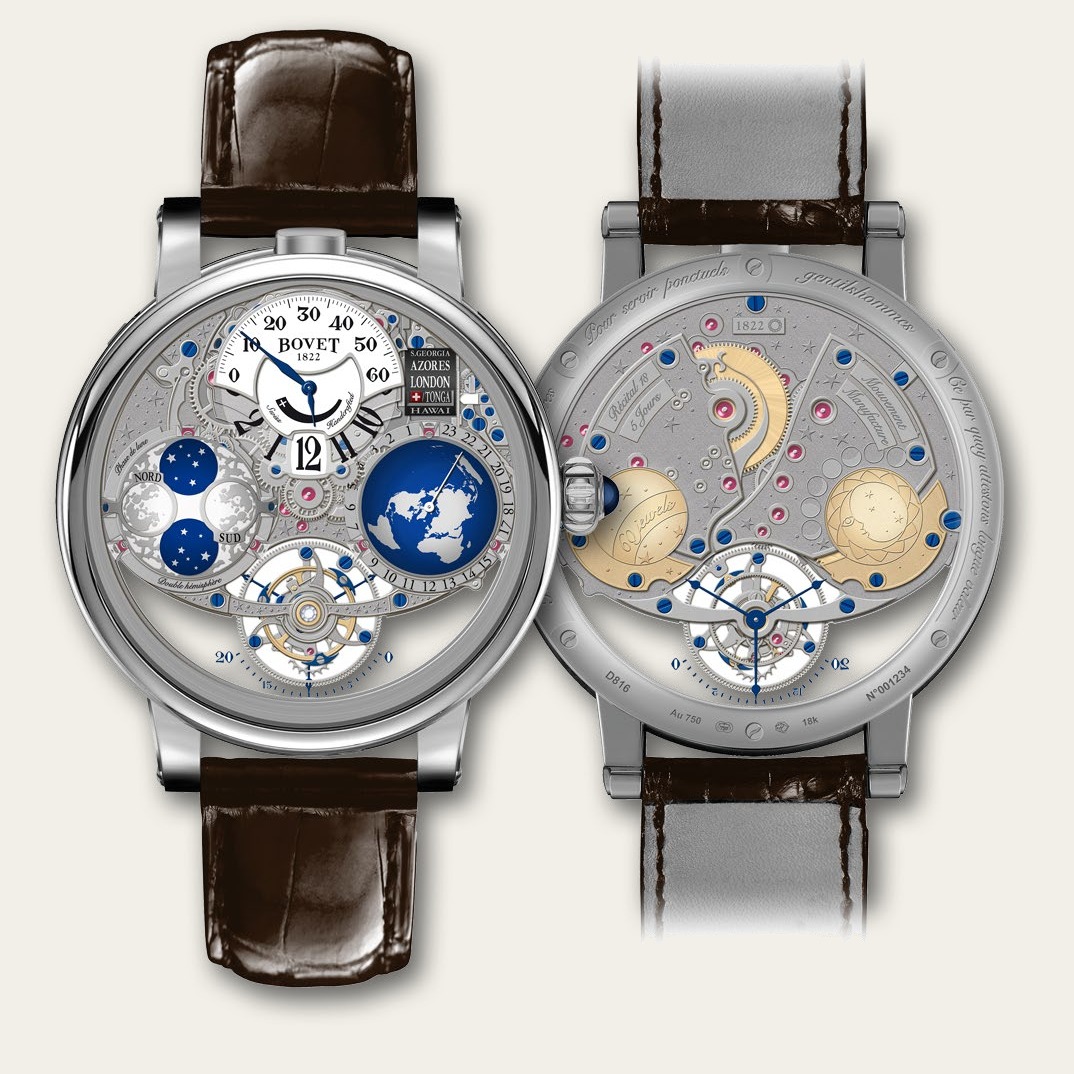
Counting the four hemispheres of the movement, the dials, the carriage and the crystal, the release tallies seven domes.
Price and availability
Production. A limited edition of 50 pieces.
Retail. CHF 295,000 (GPHG entry price for the 2016 model, excl. VAT; checked Aug 2026)
Bovet announced 50 pieces in red or white gold. The 2016 press release lists white polished lacquer or aventurine dials.
The release names no price. The GPHG record, checked in August 2026, lists CHF 295,000 excluding VAT for the white-gold R180002. That is the entry price of the 2016 watch, not a demonstrated current retail price.
Specification
Case
- Type
- DIMIER
- Size
- 46 mm
- Thickness With Glasses
- 18.15 mm
- Thickness Without Glasses
- 7.00-13.90 mm
- Material
- 18K white gold (this execution; the release also lists red gold)
- Gold Weight
- 74.57 g (white gold)
- Water Resistance
- 30 m
- Crystal
- domed sapphire with a pronounced curve; watch middle inclined along the 12-6 axis
- Notable
- hours-disk corrector positioned at 12 o'clock
Movement
- Calibre
- 17DM01-HU
- Type
- hand-wound
- Diameter
- 17''' (lignes)
- Frequency
- 21,600 vph
- Power Reserve
- 5 days
- Barrels
- 2
- Notable
- one-minute tourbillon with triple seconds-hand read under the carriage against a graduation printed inside the crystal; DIMIER escapement; hairspring manufactured in-house; three blued masses on the golden serge of the balance, after 19th-century Bovet pocket-watch balances; hand-engraved star constellation and twin hemispheres across the movement, with a moon phase represented on the back (hand engraving is sourced for the constellation, the hemispheres and the bridges only); the spec sheet lists two patents (0208-DI-CH, display mechanism with radial guidance; 0212-DI-CH, control mechanism), which the body text describes as filed
Details
- Dial
- white polished lacquer or aventurine (the release does not map dials to references, and no per-execution mapping is claimed); jumping hours on a sapphire disc read against a lacquered plate at 12 with the power reserve curved at its centre and retrograde minutes above; hemispheric universal time at 3 with a 24-hour ring and two concentric black-rhodium city rollers (white lacquered engraving); hemispheric moon phase at 9 with two circular apertures for the northern and southern hemispheres, accurate to one day in 122 years; hemispheres machined in one piece, oceans in luminescent blue, lunar craters in white luminous material, carried on three adjustable ruby runners (patented mechanism per the release)
- Straps
- full-skin alligator; 18K red or white gold ardillon buckle (the release lists both and maps neither)
Price
- Retail
- CHF 295,000 (GPHG entry price for the 2016 model, excl. VAT; checked Aug 2026)
Sources
- Bovet, Récital 18 Shooting Star press release (2016)
- GPHG, Récital 18 Shooting Star Tourbillon record (reference R180002, white gold, price)
Read next
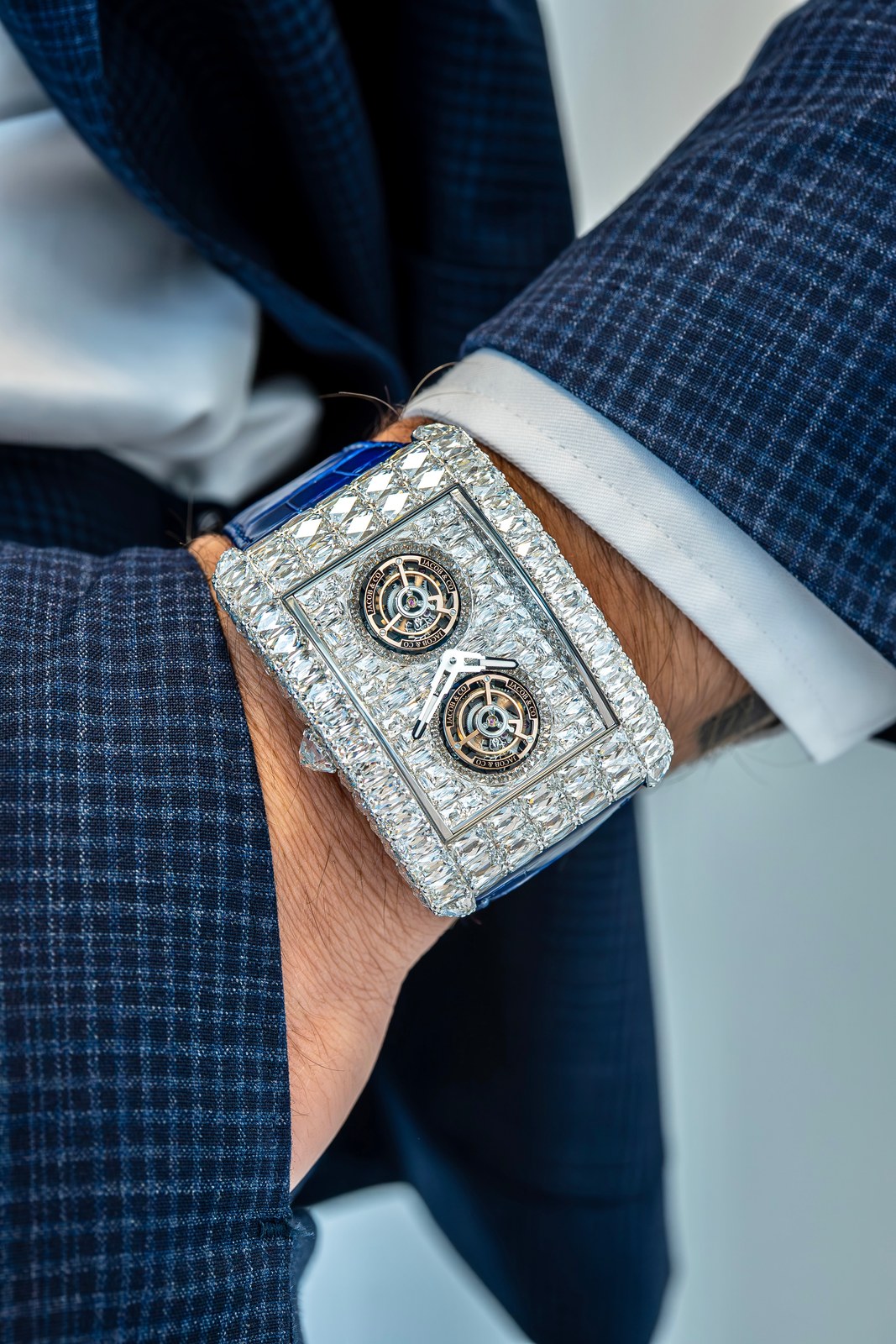
In-depth Limited · 6
The Billionaire built around a new diamond cut
In-depth Limited